Blog


Do we really know where the oil we put on our plate comes from?
Can we still trust the oil we buy? Recent results from the Canadian Food Inspection Agency (CFIA), revealing that 33% of analyzed olive oils did not comply with Canadian standards, raise a crucial question: do we really know where the oil we consume comes from? More than ever, cold-pressed vegetable oils produced in Quebec represent a local, authentic, and transparent alternative. Discover why choosing Quebec Oils means choosing quality, local expertise, and trust.
Learn more
Oliméga conquers new markets with a protein supplement for horses
Oliméga, from Saint-Édouard, has just won a $10,000 National Bank grant for its camelina meal-based protein supplement for horses—a product unique in the world. Rich in omega-3 and protein, it improves horses' mobility and coat in just seven days. Already sold in Quebec, the United States, and Japan, Oliméga will continue its international expansion in 2026.
Learn more
Vitamin E, tocopherols, and phytosterols: camelina’s natural allies
When choosing a vegetable oil, we often look at its taste or its content of good fats. However, certain natural compounds play a key role in its nutritional quality, stability, and even its versatility in cooking. This is the case for vitamin E, tocopherols, and phytosterols; three elements naturally present in camelina oil.
Learn more
Discover the stables of Quebec!
For the past few months, I've been visiting stables across Quebec to introduce Oliméga camelina products. Regardless of the type of stable—from prestigious stud farms to small family stables—one thing always stands out: the deep desire to ensure the overall health of their horses. This health encompasses nutrition, prevention, and environment, as well as the harmony between human and animal.
Learn more
Camelina: a plant champion of omega-3
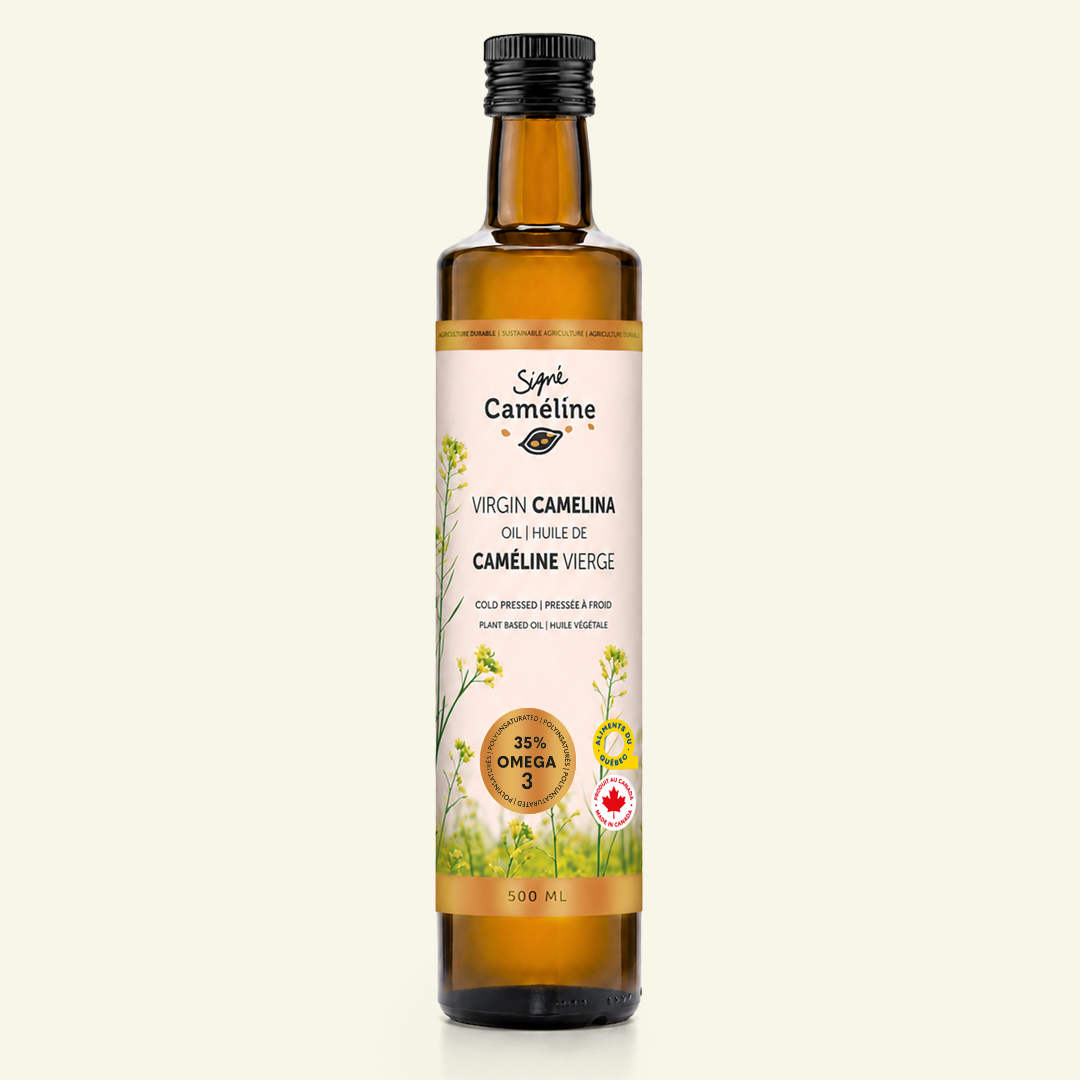
Camelina oil is renowned for its very high concentration of omega-3 fatty acids (ALA). According to scientific studies, it typically contains between 30% and 45% of its total fatty acid profile. This places it among the vegetable oils richest in omega-3s, while offering a better overall balance than many commonly used oils.
Learn more
Chantal's Diary - February 2026 Edition
Our eating habits are constantly evolving over the years and decades. We also see food trends emerge, which fuel the development of new products, linked to both local and global market trends. The food trends for 2026 revolve around five key ideas. Interestingly, camelina fits within these five emerging trends.
Learn more
Chantal's Diary - January 2026 Edition
What will we remember from 2025? An exceptional year for Signé Caméline! Introduction 2025 was a memorable year for Signé Caméline. A year where each month told a story, full of challenges, discoveries, and emotions. Between innovation, international recognition, and the celebration of our 10th anniversary, we reached significant milestones in promoting camelina in Quebec and around the world. Here is the story of the moments that marked this exceptional year. January: Heading to Lyon for SIRAH It all began under the winter skies of Lyon. We were at SIRAH, surrounded by passionate chefs and creators of flavors. This trade show wasn't just an event: it was an encounter with French culinary excellence. We exchanged ideas, learned, and dreamed of new collaborations. Thank you to Sens Gourmet for making this adventure possible. March: Tokyo and Foodex 2025 Then, off to Tokyo. Foodex opened its doors to us, revealing its fascinating world. Presenting our products in Japan was like offering a piece of our Quebec terroir to the other side of the world. And that day, my children were by my side. Seeing their eyes light up at the excitement was a moment etched in my heart. April: Innovation at the heart of our fields and our products Spring brought a breath of innovation. Our fields welcomed drones, sowing camelina with ecological precision. And then came this audacious creation: camelina oil with a buttery taste. A small culinary revolution, rich in omega-3, heat-resistant, and 100% plant-based. At the Manger Santé trade show, it won over both palates and minds. May: International recognition May was a month of triumph. Our buttery-tasting oil won first place at the SIAL Innovation Canada 2025 competition. Out of 170 entries from 13 countries, we stood out. This award is much more than a trophy: it's recognition of our commitment to innovation and sustainability. June: 10 years of Signé Caméline June was a celebration. Ten years of history, passion, and hard work. We opened our doors, shared our secrets, and showed off our fields in bloom. You tasted, learned, laughed, and even met our animals. That day, our combine harvester and our drone stole the show. An unforgettable day. August: Butter-flavored Fitspray Summer brought a new idea: Fitspray. In collaboration with Fitcook, we created a convenient and delicious butter-flavored oil spray. An innovation that transforms healthy cooking into a simple pleasure. September: Autumn sowing by drone When autumn arrived, our drones resumed their aerial dance above the fields. Sowing autumn camelina is about preparing for biodiversity and the future. A sustainable vision that guides us. October: Global Summit of Women in Agritech In October, we crossed borders to Belgium. Invited by Prince Édouard de Ligne La Trémoille, we participated in the World Summit of Women in Agritech. There, we discussed innovation, sustainability, and the essential role of women in the agriculture of tomorrow. November: Expansion of our factory Before the year ended, we launched an ambitious project: to triple our production space. To share the benefits of camelina even more widely with the world. Conclusion: Onward to 2026! 2025 was a year of growth, innovation, and invaluable encounters. Thank you to everyone who wrote this story with us. And now, we're setting our sights on 2026, with even bigger dreams and projects that will make our hearts beat faster. 👉 Discover our innovative products and follow us to stay up-to-date on upcoming news! Happy New Year 2026! Chantal xox
Learn more
Chantal's Diary - December 2025 Edition
Camelina in winter: how it survives the Quebec cold By Chantal, founder of Signé Caméline Discover how the camelina protects itself during the Quebec winter and why snow is its best ally. When the cold weather sets in in Quebec, our crops face extreme conditions. Camelina, a hardy plant prized for its oils, has a natural strategy for surviving the winter: dormancy. But how does it work? And what are the risks in the event of intense cold? Winter isn't always mild… and I'm going to explain why. When the cold sets in The camelina plant enters dormancy to protect itself and await spring. This mechanism slows its metabolism and allows it to conserve energy until the return of warmer weather. Its best ally: snow A blanket of snow and normal temperatures? That's exactly what camelina needs to survive the winter safely. The snow acts as a natural insulator and protects the roots from sudden temperature changes. When I see our fields covered in snow, I know the camelina is well protected. Beware of extreme cold Several consecutive days at -30°C can be damaging to crops. Normal temperatures are expected for southern Quebec this winter. What is camelina? Camelina (Camelina sativa) is an oilseed plant cultivated for over 3,000 years in Europe. Rediscovered for its exceptional qualities, it adapts perfectly to the Quebec climate. This hardy plant produces oil-rich seeds, renowned for their high omega-3 content and antioxidant properties. And the best part? It requires little water and little fertilizer. A true champion of sustainable agriculture. The benefits of camelina oil 1. Cardiovascular health Rich in omega-3 (35-40%), camelina oil contributes to heart health and helps reduce inflammation. 2. Natural Antioxidants Its high content of vitamin E and tocopherols protects cells against oxidative stress. 3. Skin care Used in cosmetics for its moisturizing and regenerating properties, ideal for sensitive skin. 4. Ecological Culture Requires little water and fertilizer, resists disease and improves soil structure. The camelina cycle in Quebec Autumn — Sowing We sow before the frost so that the roots can establish themselves. Winter — Dormancy Under the snow, she sleeps, protected. Spring — Growth As soon as the thaw begins, the camelina resumes its growth rapidly. It flowers in May-June with pretty pale yellow flowers. Summer — Harvest In July, these golden seeds, dried in the field, are harvested, ready to become an exceptional oil. Each pod contains precious seeds, brimming with beneficial properties, ready for extraction. My tips for a successful winter • Sowing at the right time — Sow 4-6 weeks before frost to allow for good root development. • Adequate drainage — Avoid poorly drained soils where stagnant water can freeze and damage roots. • Snow cover — Snow acts as a natural insulator. A minimum of 10-15 cm effectively protects plants. • Monitor the thaw — Repeated freeze-thaw cycles in spring can be more damaging than constant cold. Camelina is a resilient and sustainable crop that provides us with an oil of exceptional benefits. Its cycle is simple yet fascinating: sowing in autumn, dormancy in winter, growth in spring, and harvest in summer. And every step counts. We're hoping for a normal winter in southern Quebec. The camelina itself has indeed gone dormant with this light dusting of snow. Happy start to winter! Chantal xx #SustainableAgriculture #SignedCaméline #QuebecWinter #Omega3 #LocalProduce #OrganicFarming
Learn more
Cooking with camelina: ideas and recipes from Mélanie Germain
When Mélanie introduced camelina into her cooking, she didn't expect such a strong reaction. Between the omega-3 rich oil, the texture of the seeds, and the famous butter oil, she quickly adopted camelina from steak to dessert. In this article, we gather her impressions, her favorite recipes and the reasons why camelina has definitely earned its place in her pantry.
Learn more