Camelina: a plant champion of omega-3
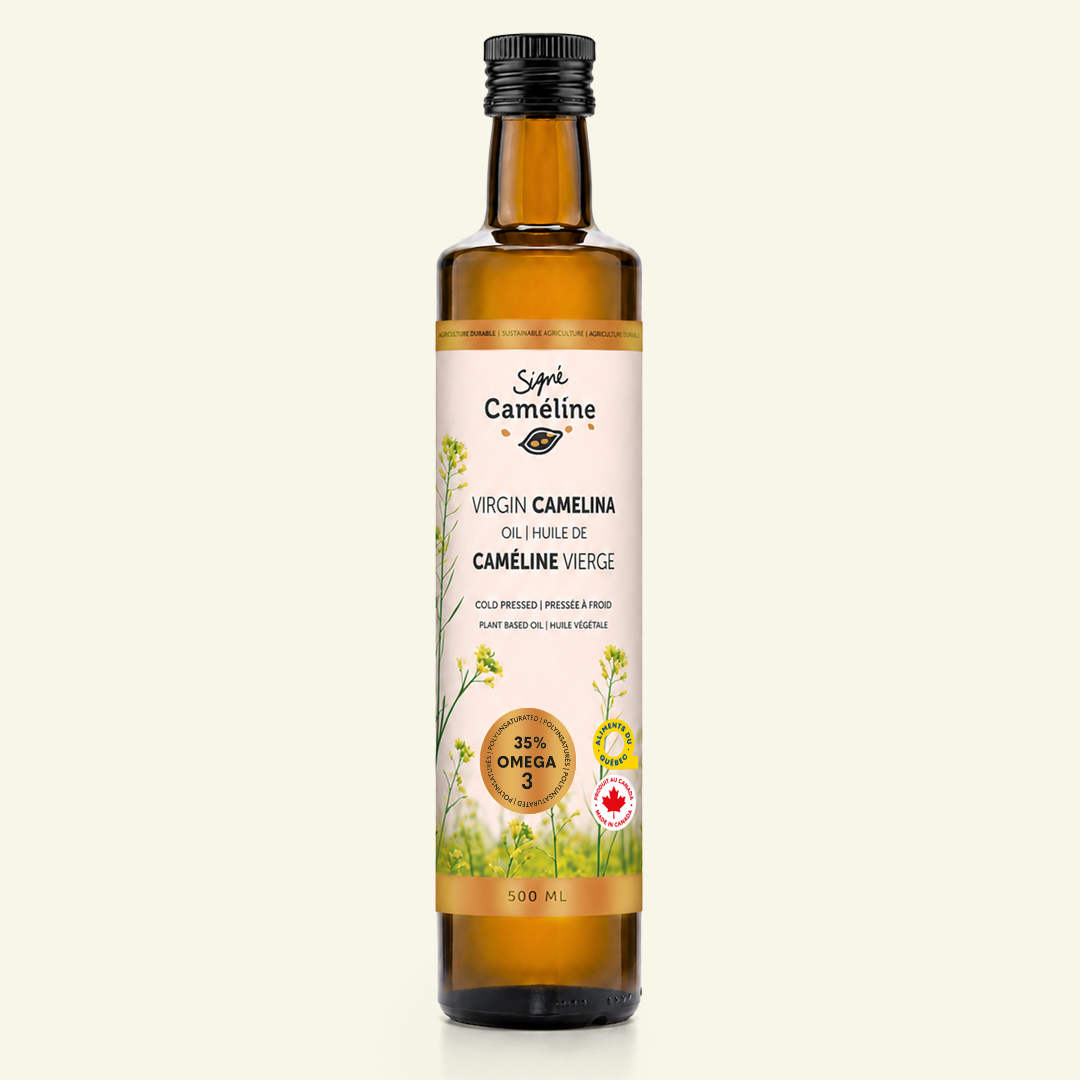
Camelina oil is renowned for its very high concentration of omega-3 fatty acids (ALA). According to scientific studies, it typically contains between 30% and 45% of its total fatty acid profile. This places it among the vegetable oils richest in omega-3s, while offering a better overall balance than many commonly used oils.
Comparison with other plant sources
|
Vegetable oil |
Approximate omega-3 (ALA) content |
|
Camelina |
~30 to 45% |
|
Linen |
~50 to 60% |
|
Rapeseed (canola) |
~8 to 10% |
|
Soy |
~7% |
|
Olive |
< 1% |
While linseed oil remains the most concentrated, camelina oil stands out for a major advantage: its natural stability, linked to its high vitamin E content. As well as its exceptionally high smoke point of 475°F.
Vitamin E: the key to the stability of camelina oil
When evaluating an oil rich in omega-3, the quantity is not the only important criterion. Omega-3s are fatty acids highly sensitive to oxidation: heat, light, and oxygen can quickly degrade them.
The essential role of vitamin E
Vitamin E (tocopherols) is a powerful natural antioxidant. It protects polyunsaturated fatty acids from oxidation and slows down the rancidity of oils.
Camelina oil naturally contains a significant amount of vitamin E, which gives it remarkable oxidative stability, even with a high omega-3 content.
Omega-3: Beyond marine sources
Oily fish are often presented as the gold standard for omega-3, but this reliance on marine sources raises several issues:
- Pressure on fish stocks
- Environmental impacts
- Incompatible with vegetarian or vegan diets
Camelina demonstrates that it is possible to obtain high-quality omega-3 from a terrestrial, renewable, and local crop, while meeting modern nutritional needs.
Camelina: a nutritional and eco-friendly choice
Thanks to :
- Its high content of plant-based omega-3
- Its natural richness in vitamin E
- Its superior stability
- Its balanced omega-3 / omega-6 profile
Camelina is emerging as a sustainable and intelligent alternative to marine oils and other vegetable oils.
It perfectly embodies the idea that omega-3s can be plant-based, effective and environmentally friendly.
Scientific sources
- Budin, J.T., Breene, WM, & Putnam, DH (1995). Some compositional properties of camelina (Camelina sativa L. Crantz) seeds and oils . Journal of the American Oil Chemists' Society.
- Zubr, J., & Matthäus, B. (2002). Effects of growth conditions on fatty acids and tocopherols in Camelina sativa oil . Industrial Crops and Products.
- Zubr, J. (2003). Qualitative variation of Camelina sativa seed from different locations . Industrial Crops and Products.
- Abramovic, H., & Abram, V. (2005). Physico-chemical properties, composition and oxidative stability of Camelina sativa oil . Food Technology and Biotechnology.
- Simopoulos, A.P. (2002). Omega-3 fatty acids in inflammation and autoimmune diseases . Journal of the American College of Nutrition.